

Why genuinely random draws look clumpy
LottoBase Team 3 August 2026 5 min read
Look down a list of past Lotto draws and something usually jars. One number turns up three times in a fortnight; another has not been seen since the spring. It looks, faintly, as though the draw is playing favourites. This post is about why it isn’t — why clumps, streaks and quiet spells are exactly what a genuinely random draw produces, and why a neat, even spread would be the odder result.
First, what “random” actually means
Toss a coin. Heads or tails, half a chance each. Toss it again, and the coin has no idea what it did a moment ago — the second toss is decided entirely afresh. That is all “random” means here: each result is settled on its own, with nothing carried over from the last one. Statisticians call results like these independent, which is just a formal way of saying that nothing links one toss to the next.
Now a small experiment that catches most of us out. Ask someone to write down twenty coin tosses from imagination, then toss a real coin twenty times alongside it. The invented list is almost always the tidier of the two — heads, tails, tails, heads, tails, heads — rarely more than two or three of the same in a row, because a longer run feels wrong. The real coin will happily hand you four or five heads together. Those streaks are not a flaw in the coin; they are what an honest coin does.
Nothing is spacing the numbers out
The next thing to notice is what is missing from a lottery machine: anything that keeps track. No mechanism inside it is thinking “37 has had a quiet run, let’s give it a turn”. The balls tumble, six drop out, and the machine is reset. Each draw is settled afresh, exactly like the coin.
Think of rain starting on a paved patio. The first drops do not arrange themselves politely, one per slab — two land almost on top of each other here, while a slab over there stays dry. Nobody would say the rain was favouring one corner. Randomness is not the same thing as tidiness; it just means no rule is deciding where the next drop goes. Lottery numbers arrive the same way, and clump for the same reason.
What that looks like across real draws
Put a number on it. Lotto draws six main balls from 59, so any single number turns up in six draws out of every fifty-nine — a little over one draw in ten.
“One in ten” sounds like clockwork, as though each number should appear every tenth draw. It is nothing of the sort: it is a long-run rate, an average taken over a great many draws, and averages hide the lumps. Take any twenty consecutive Lotto draws — 120 balls in all, so about two appearances each if they shared themselves out neatly. In practice you will typically find several numbers that never appeared, and two or three that turned up five times or more. That is simply what one-draw-in-ten looks like across twenty draws.
Why an even spread would be the strange result
Here is the part that flips the intuition. Picture every possible way twenty draws could have fallen — a vast collection of outcomes, each as likely as any other. Only a tiny fraction are neat, with every number appearing close to its fair share; the overwhelming majority are lumpy, some numbers over-represented and others missing entirely. There are simply far more untidy arrangements than tidy ones, so untidy is what you get.
Which means a draw history that kept coming out evenly, week after week, would be the genuinely odd one — it would suggest something was quietly smoothing the results, and nothing is.
Where you can see this in LottoBase
The pattern is there to be looked at, on any number you like. On the Numbers tab, tap a number to open the Number Picker and switch to its Insights tab. Alongside “Last seen N draws ago” and “Appeared in N% of draws”, the Ball Frequency Pattern lays that ball’s appearances out over time — and it looks precisely as described above: two or three bunched together, a long quiet stretch, then another cluster. Move between the 3M, 12M and All Draws periods and the clumping does not tidy itself up.
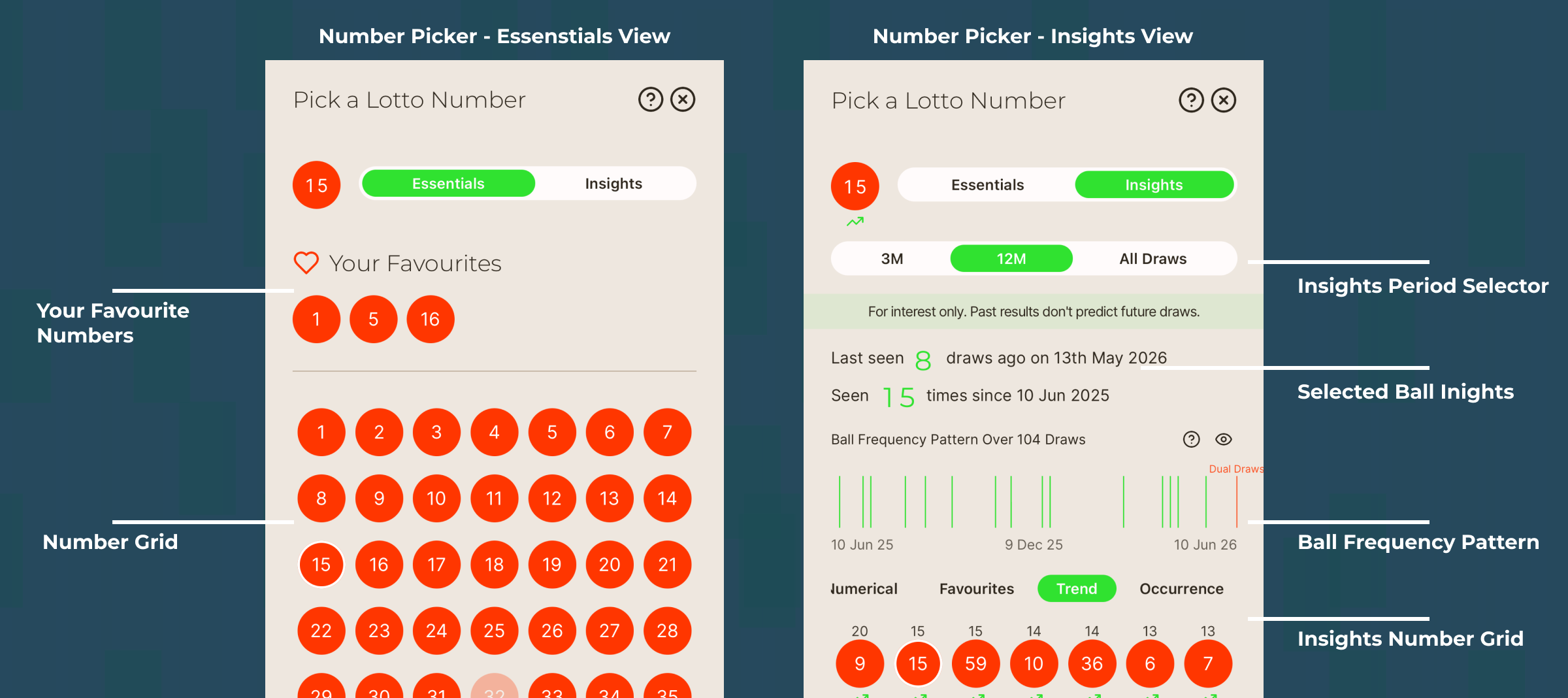
Tap a number to open the Number Picker — Essentials for your Favourites, Insights for that ball’s history.
The Insights icons describe the same history in shorthand: a green arrow for a number appearing more than its fair share of late, a blue clock for one that has gone longer than its own usual gap. Both are statements about draws already held. None of it changes the odds — it is a way of seeing what past draws have done, and of choosing your numbers with some sense of the shape behind them.
The short version
Random does not mean evenly spread. It means nothing is deciding what comes next — and with nothing spacing the results out, clusters and quiet spells are the natural outcome rather than a curiosity. A number appearing three times in a month while its neighbour sits out until autumn is the draw history behaving exactly as it should. It is a game of chance, so play only what you can comfortably afford, and read the clumps for what they are: the texture of randomness, not a signal in it.