

Syndicates Explained: How Group Play Works and What to Agree Up Front
LottoBase Team 24 August 2026 4 min read
Group play is one of the commonest ways people play the National Lottery — the office ten, the family five, the same four names in the pub every Saturday. Most syndicates run on nothing more than good faith, which works right up until the week it doesn’t. This post covers what a syndicate is, what pooling money does to your chances, and what is worth settling before the first ticket is bought.
What a syndicate is
A syndicate is a group of people who put money into a common pot and buy lottery entries with it. Any prize is divided between the members according to shares agreed in advance, and one person — the syndicate manager — does the buying and looks after the ticket.
A typical example: ten colleagues each put in £2 a week, the pot buys ten Lotto lines, and anything those lines win is split ten ways. Nothing about the games themselves changes.
More lines, smaller slices
Start with what “odds” means. Picture a raffle where a hundred tickets are sold and one is pulled from the hat: hold one ticket and your chance is 1 in 100, one outcome in your favour out of a hundred possible ones. A Lotto line works the same way, only the hat is enormous. There are 45,057,474 different six-number lines that could come out, so any single line has a 1 in 45,057,474 chance of being the jackpot line.
Buy ten different lines and the group holds ten of those raffle tickets instead of one, so it has ten chances rather than one. What has not moved is the chance attached to each line. That is set by the game, and no arrangement between players alters it — a line held by a syndicate is neither better nor worse than the same line held alone. And if one of the ten comes up, the prize is cut ten ways.
That is the trade in a sentence: a syndicate wins more often than a lone player spending the same money, and takes home less each time it does. Two pounds a week is two pounds a week whether it goes into the pot or over the counter. What differs is the texture — a group covering ten lines sees smaller prizes turn up far more regularly, and that steadier trickle is a good part of why syndicates keep going.
Settle these before you start
Almost every syndicate dispute comes from something nobody discussed while there was no money on the table. Agree these at the outset, in writing:
- Who buys, and by when — one named manager, a deputy for holidays, and a cut-off time before the draw.
- What everyone pays, and what a share is. Equal contributions make for equal shares; if they differ, write the split down in proportion.
- What happens if someone misses a week. Are they in for that draw or not? The most argued-about point in group play, and it costs nothing to settle in advance.
- Which numbers you play, and whether they stay fixed week to week.
- What happens to small wins — paid out, or rolled into next week’s entries.
- How a large prize would be handled. A written agreement made before a win is what a syndicate falls back on afterwards. If a significant sum is ever in play, take proper advice rather than improvising.
None of this needs to be formal. A dated note every member has a copy of is enough, and far easier to write in an ordinary week than in an extraordinary one.
Keeping the ticket side straight
The manager’s real job is administrative: buy on time, keep the ticket safe, and be able to answer “did we win anything?” without a shrug.
Scanning the ticket into LottoBase handles the checking. From the Games or Tickets tab, tap Scan Ticket and line the ticket’s QR code up inside the green corner guides; it appears in the Tickets tab as a Scanned ticket, already set to Tracking, and is then checked against every draw it is entered in as the official results arrive. The ticket name is editable on the Edit Ticket screen, so “Thursday Office Ten” sits clearly apart from the manager’s own tickets.
When members ask what happened, the ticket card carries the headline answers — winning lines, ticket cost, total winnings, draws left. For the detail, its Edit button opens the Edit Ticket screen, where switching to Winning Lines lists each winning line with its prize tier: the band it won in, according to how many numbers matched.
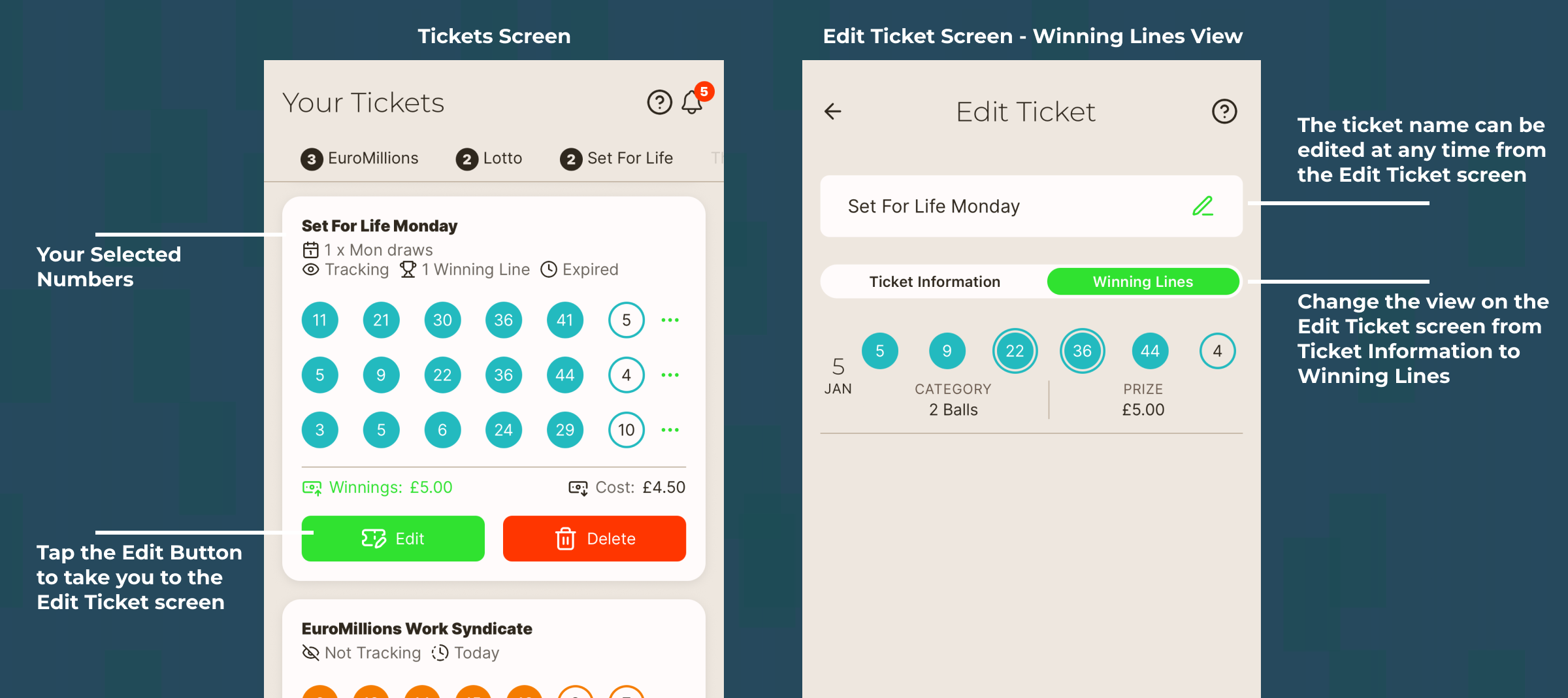
A ticket’s Edit button opens the Edit Ticket screen; switch to Winning Lines to see each win’s prize tier.
Two reminders are worth turning on as well. A claim reminder matters more for a group than for an individual, because a prize nobody chased is a prize several people have lost, and National Lottery prizes must be claimed within 180 days of the draw. The Expired Ticket Alert is the other: syndicates often buy several draws ahead — up to four weeks, or eight consecutive Lotto or EuroMillions draws — and the alert marks the point at which the next ticket needs buying.
LottoBase does not collect subscriptions or divide up winnings; that stays between the members. What it removes are the two failures that actually sink syndicates: nobody checked, and nobody bought this week. The rest is just the lottery — a game of chance, best played with what the group can comfortably afford.