
Lottery balls have no memory: why no number is ever 'owed' a draw
LottoBase Team 22 June 2026 5 min read
Most of us have done it. You glance down the list of numbers, notice one that has not turned up in months, and a little voice says: surely it’s due by now. It feels like plain common sense — things even out in the end, don’t they? This post is about that little voice, and why, however reasonable it sounds, it is leading you astray.
The balls have no memory
Picture the draw machine on a Saturday night. The balls tumble around, six drop out, and that is that. Now picture one particular ball — say number 37 — that has sulked at the bottom of the machine for the last fifty draws without being picked.
Here is the thing worth sitting with: number 37 has no idea it has been left out. It is not keeping score, nursing a grudge, or waiting for its turn to come round. A ball cannot remember the last draw, because a ball remembers nothing at all. Every Saturday it goes back into the machine on exactly the same footing as all the others, with exactly the same chance of dropping out.
And that chance never moves. In Lotto, six balls are drawn from 59, so any single number has a 6-in-59 chance of being among them — a touch over 10%, every single draw, no matter what happened the week before. A number that has been quiet for fifty draws is no more likely to appear than one that came up yesterday. The machine does not owe it anything, because the machine does not know it exists.
”But don’t the numbers even out?”
This is usually where people push back, and they have a point. Look at the draw history over a long enough stretch and the numbers really do appear about equally often. So something is evening out. Doesn’t that prove the quiet numbers must catch up eventually?
It is a fair question, and there genuinely is a real piece of maths underneath it. (It even has a grand name — statisticians call it the law of large numbers — but the name matters far less than what it actually says.) What it says is this: the more draws you pile up, the closer each number’s appearance rate creeps toward that same ~10%. Stretch the history long enough and the numbers crowd together near the same figure.
All true. The catch is how they get there — and it is not by quiet numbers catching up.
The glitter in the swimming pool
Imagine tipping a spoonful of glitter into a small glass of water. It looks dramatic: the glitter swirls everywhere, and the glass is obviously, visibly full of the stuff. That glass is a lottery after only a few hundred draws — small, and lumpy, with some numbers clearly ahead and others clearly behind.
Now tip that same spoonful of glitter into a swimming pool. Stir it through, and you would struggle to find a single fleck. Nothing removed the glitter. Nobody scooped it out. The pool is simply so vast that the same amount of glitter is spread impossibly thin.
That is exactly how a lottery “evens out.” Suppose a number falls a handful of appearances behind after a thousand draws. Nothing reaches back to fix that gap — there is no catching up. Instead, as tens of thousands more draws pile on top, that fixed little shortfall becomes a vanishing speck in an enormous pool of draws. The gap itself can even grow in absolute terms; it is the share of the total that shrinks toward nothing. The numbers converge by dilution, by sheer weight of draws washing over the early lumps — never by a balancing hand reaching in to settle a debt.
Why real draw histories still look lumpy
There is a sting in the tail. That swimming pool is far, far bigger than any real lottery. “The long run” here means tens of thousands of draws — and since the 59-ball format began in October 2015, Lotto has held on the order of a thousand. In glitter terms, we are still very much looking at the glass, not the pool.
So of course the history looks uneven: some numbers sit a little above the pack, some a little below, streaks and quiet spells come and go. That is not a glitch, and it is certainly not a clue about Saturday. It is simply what the early, lumpy stretch of a very slow evening-out is supposed to look like.
How this reads in LottoBase
LottoBase’s Insights are built to show this history honestly rather than to tidy it away. Open the Number Picker on any number, switch to its Insights view, and you can see how often that ball has actually appeared — “Appeared in N% of draws” — alongside a Ball Frequency Pattern that lays its occurrences out over time, gaps and clumps and all. Set the Insights Period to All Draws and those percentages are exactly the rates we have been talking about, caught mid-evening-out.
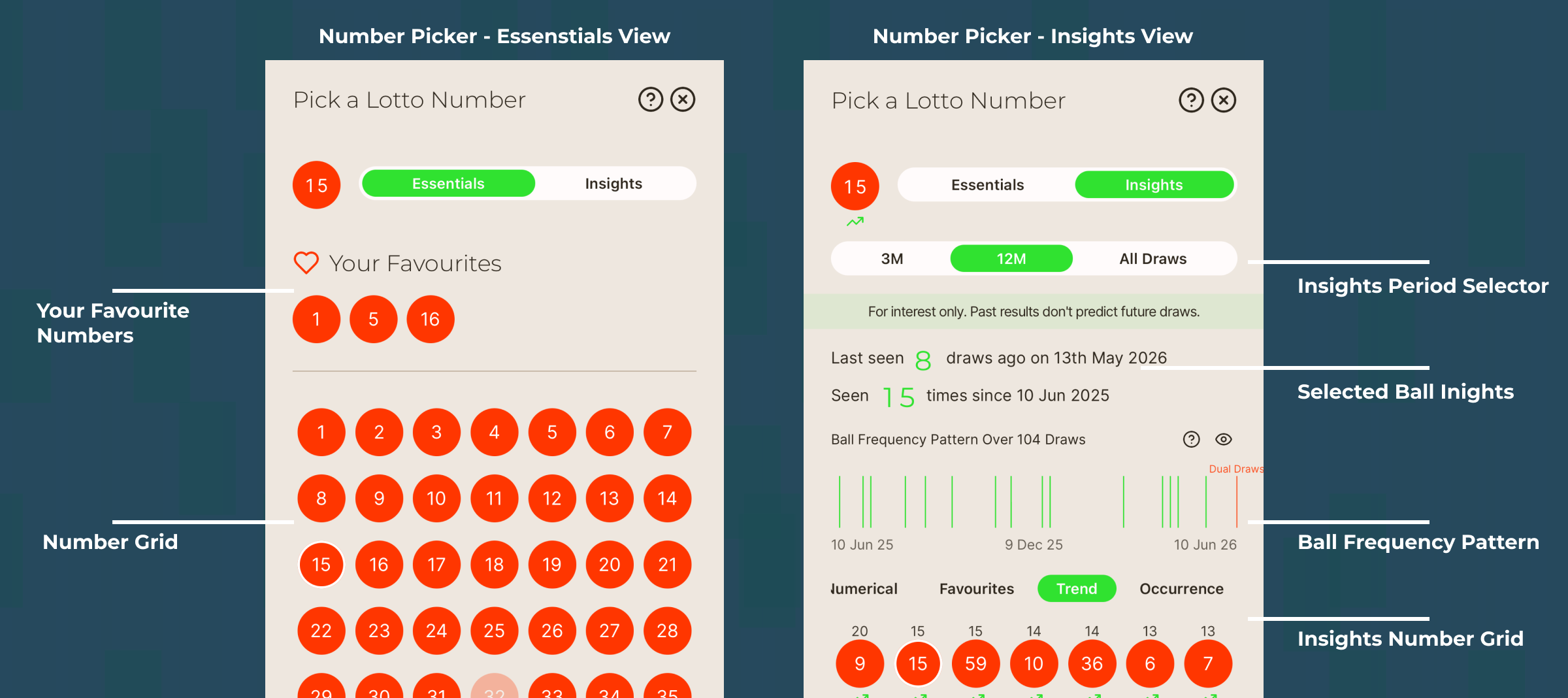
Tap a number to open the Number Picker — Essentials for your Favourites, Insights for that ball’s history.
It is worth being clear about one label in particular. LottoBase marks some numbers with an “overdue” blue clock, which simply means a ball has gone longer than its own usual gap without appearing. That is a fact about the past — about the wait since its last draw — and nothing more. It does not mean the number is due, and it carries no pull toward the next result. None of the Insights change the odds; they are a way of seeing what past draws have done, offered so you can choose your numbers with a sense of intention rather than predicting anything.
The short version
The balls have no memory. Each draw stands entirely on its own, and the odds for every number are identical and fixed — a quiet number is never “owed” a turn. Numbers really do even out over the very long run, but by dilution, like glitter lost in a swimming pool, not by anyone catching up. The lottery is, and remains, a game of chance, so play only what you can comfortably afford — and read the patterns for the story they tell about the past, not as a forecast of the next draw.